Why should businesses visualize their processes, and what steps await those who take the plunge?
The term “business process” is quite vague. For example, when it comes to the process of “sales,” each employee sees a unique set of steps and actions. If the business plans to expand or move towards automation, this becomes a problem.
BPMN 2.0 helps businesses and individuals reach an agreement and describe processes in a way that is clear and unambiguous for everyone. However, approaching the notation is not easy, and we asked managing partner of Project Management Bureau, Oleksii Gromyko, to tell us more about working with BPMN 2.0 and its benefits for the company.
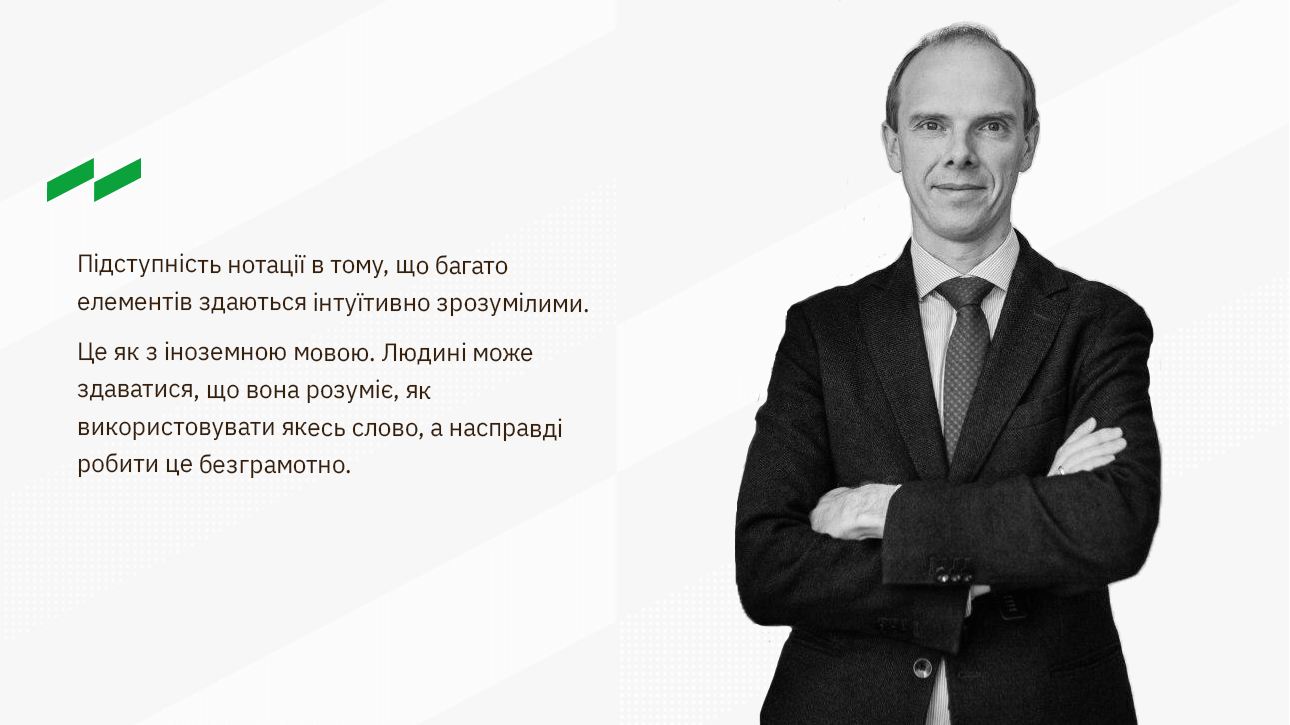
Oleksii Gromyko has been working with BPMN 2.0 notation for over 10 years. “Visualizing processes using this notation is a mandatory step that I use in all my projects. It’s a key element and the value I create as a consultant,” explains the expert.
Oleksii Gromyko’s portfolio includes over 50 projects where BPMN 2.0 was applied. His client list includes Nova Poshta, EVA, IDS Borjomi, Yuriay-Pharm, Ferrexpo, and dozens of other brands.
To begin, could you tell us why and when consultants started using BPMN notation?
Historically, the first notation appeared over 100 years ago. It was a simple flowchart. In the 1970s, it became clear that this was insufficient: flowcharts didn’t allow for building process hierarchies (when there’s a large process, we can’t “drill down” to lower levels to clarify its subprocesses). Additionally, flowcharts didn’t work with events. They didn’t show, for example, that a client request could come in or that additional information might be needed at some point. This led to the need to develop the flowchart concept further, and thus, process notations emerged. In 2003, a community of leading consultants worldwide came together to develop a unified business process visualization language.
This didn’t happen by chance in 2003. That’s when automation started gaining tremendous momentum, and it became clear that businesses and IT needed to develop a clear system of notation. In 2004, BPMN 1.0 notation was introduced, and in 2009, a draft version of 2.0 was released, which was officially approved in 2011.
The entire model logic is based on determining who is responsible for performing each step. This means that it’s impossible for a failure to occur simply because each participant thought someone else was responsible for the work.
How does the second version of the notation differ from the previous one?
The 2.0 suffix highlights that this is a mature notation, not something that was just invented yesterday. It has been validated over time. But, of course, this is not the only change. Along with BPMN 2.0 notation, the concept of “executable business processes” emerged. This means that if we model a business process using BPMN 2.0, it can definitely be automated in the form it was modeled. For IT specialists, this is a significant difference.
Moreover, this is the first notation where the responsibility of performers is clearly defined. The entire model logic is based on determining who is responsible for performing each step. This means that it’s impossible for a failure to occur simply because each participant thought someone else was responsible for the task.
Do I understand correctly that a process described using BPMN 2.0 notation can be universally understood by specialists around the world?
On the one hand, all the elements of the notation are clearly defined. However, besides the rules, there is also the concept of “modeling style.” The style is what makes the model unambiguously readable within the company. These two aspects are always discussed in detail during our training sessions.
When should companies start modeling processes?
Every time their employees want to make improvements to business processes.
Do modeling styles differ for different companies?
Using BPMN 2.0 notation, the same situation can be modeled in various ways. Therefore, we recommend that every organization develops an internal Modeling Agreement. This is standard practice. The style agreement complements the standard rules. If we draw an analogy, it’s like the general rules of a particular language and the editorial policy of a specific magazine.
When should companies start modeling processes?
Every time their employees want to do something with business processes. For example:
make them clear for the whole team,
create operational guidelines,
define areas of responsibility,
prepare the process for automation,
set up a risk management and compliance system (ensuring conformity with internal or external requirements and standards),
onboard new employees quickly,
optimize processes.
The first step for each of these tasks is to build a process model.
Where should a specialist begin when learning the notation?
The tricky thing about the notation is that many of its elements seem intuitively clear. And if you start using them without consulting or clarifying the rules, it can lead to mistakes. It’s like with a foreign language. A person may think they understand how to use a particular word, but in reality, they might be using it incorrectly.
The minimum set of symbols, standardized for all countries and languages, allows people from different specializations to unambiguously interpret what is happening in the process.
Why use notation if the process can be described in text?
Visualizing a process frees you from the need to write things like: “Now N should perform this task and pass the result to M.” Instead, we just draw a rectangle and write the task the employee should complete, then use an arrow to show what happens next. We don’t write “a client approached us,” we use the event “client inquiry.” And everyone understands what that means. The minimal set of symbols, standardized across all countries and languages, allows people from different fields to unambiguously interpret what is happening in the process.
What key skills will a person gain after completing the course “Business Process Modeling in BPMN 2.0 Notation”?
First of all, they will understand how to build a process model: where to start and how to use the basic elements. We will discuss modeling styles and what that means: why it’s not enough to just use elements, but important to build a model that is unambiguous for everyone. How to allocate responsibility among process participants. How to see the hierarchy of a specific process: its structure (sub-processes) in a three-dimensional view, as well as the overall interconnection of processes within the company. And, of course, when modeling a process, it becomes clear where the bottlenecks are and the opportunities for optimization.
What should a specialist do after the training session when starting to work with the notation?
The first thing a participant should do after the training is to choose one process, build its model, and agree with all participants that it will be described in this way.
The process to start with depends on the goal:
making your operations transparent,
improving specific metrics or customer experience,
implementing ERP/CRM/… systems,
or simplifying the employee onboarding process.
But it’s important to remember: notation is just a tool. A process description has no meaning if you don’t understand what specifically should be done with it and why. In other words, it’s crucial to first define your goals, and only then build the model using the notation. Our other training course, “Business Process Management”, will help with goal-setting.
Adaptability to change doesn’t come from the notation itself, but from the fact that people start to better understand how the process is structured. In this way, the notation helps the business become more flexible.
Experts say that notation helps a business become more adaptable to change. How does this work?
Adaptability to change doesn’t come from the notation itself, but from the fact that people begin to better understand how the process is structured. In this way, the notation helps the business become more flexible. It’s impossible to make adjustments quickly when you don’t understand how the process is organized. The notation helps both identify issues in the processes and allows you to look at the process from the outside.
During the training course, we explain how to model a process correctly from an outside-in perspective: that is, to view it from the customer’s point of view. We also remind participants not to fragment processes. The right model helps connect all departments of the company into one value creation chain.
How can you prepare for the training course to make it as beneficial as possible?
The key question to ask yourself is: what’s not working in the processes in my company? If there’s any dissatisfaction at all, it’s time to attend the course. It will help make this feeling tangible and allow you to understand what’s going wrong.
In addition, it’s important to understand why we are building a process model: this helps choose the right perspective and level of detail.
During the course, we explain how to model a process correctly from an outside-in perspective: that is, to view it from the customer’s point of view. The right model helps connect all departments of the company into one value creation chain.
Throughout the course, students will work with real processes from their companies. It’s recommended to choose processes you are familiar with, or ask your colleagues for details about the process. But even if there isn’t enough information, it’s not a problem. The notation itself helps you realize when there’s missing information. And this can only be discovered by building the model.
Choose a topic that interests you and read the most popular and useful articles from the Bureau: