Process mining is often presented as a tool that allows an organisation to see how its processes actually work, rather than relying on the idealised version that exists in procedures, presentations, or the assumptions of management.
The idea is highly attractive: analyse the data, connect AI, and the company will see delays, bottlenecks, rework loops, inefficient process paths, and hidden problems in the way departments interact.
In practice, however, many organisations face a different reality: the tool has been purchased, but the expected business impact has not materialised.
The reason is usually not the tool itself. Process mining does not improve processes automatically. It makes reality visible, and often that reality is something the company is not yet ready to work with.
In our experience, there are four main reasons why process mining may fail to deliver the expected result.
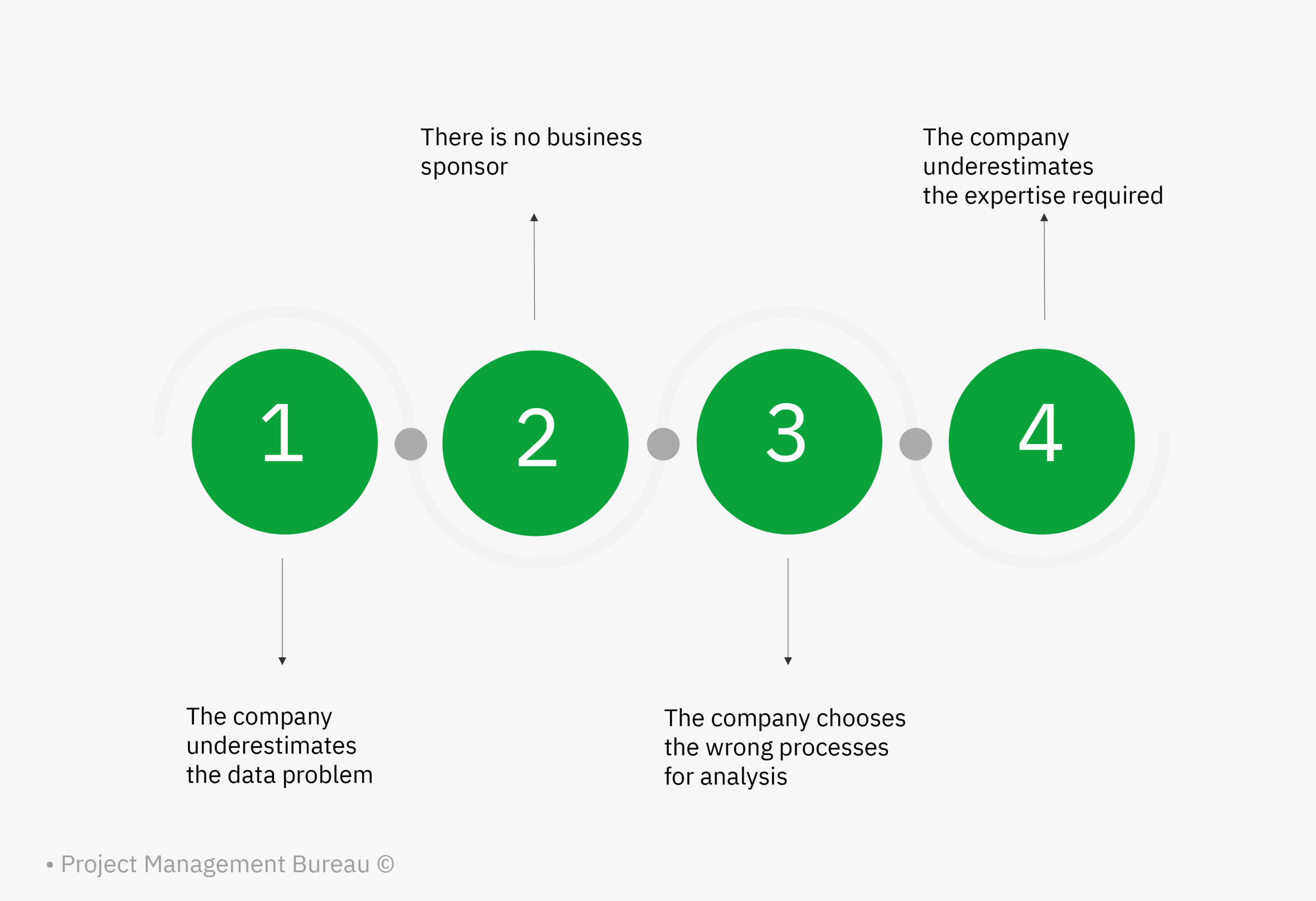
Process mining is based on events recorded in information systems. But the mere presence of an ERP, CRM, or Service Desk system does not mean the company has data that is suitable for analysis.
Process mining requires more than records in a system. It requires the key events in a process to be captured: which process they belong to, what happened, and when it happened.
In practice, several problems often arise.
Process data may not be stored at all, or it may be stored only partially. For example, the system may record the creation and closure of a request, but not the intermediate approvals, returns, or handovers between departments.
An even more complex situation arises when the system does not record the start and end of individual process steps. In this case, the company cannot accurately calculate waiting time or cycle time, and therefore cannot understand where the process is simply waiting for the next action.
Companies also often lack the attributes needed to analyse the causes of deviations. We may see that some requests move faster and others more slowly. But if the data does not include information about the customer, product, request channel, region, or employee handling the request, it becomes difficult to explain why this is happening.
A separate problem is process fragmentation across different systems. A process may start in CRM, continue in ERP, pass through an electronic document management system, and end in accounting software. Without a single end-to-end process identifier, the company sees not the full process, but separate fragments.
Poor data does not become better simply because it has been loaded into a modern tool.
In this case, process mining risks becoming a visually impressive but practically limited form of analysis.
The second reason is that process mining is often treated as an IT or analytics tool. This narrows its management value.
The tool can show delays, repeated approvals, unusual process paths, or an excessive number of process variants. But these findings need to be interpreted.
For example, the system may show that some requests are regularly returned to a previous stage. But this may point to very different issues:
Without business context, the results of the analysis can be misinterpreted.
The findings also need to be turned into decisions. It is not enough to see a list of potential problems. The company needs to determine:
After that, the organisation needs to move from analysis to change: review process rules, roles, control points, KPIs, system settings, or the way departments work together.
Process mining does not create the final result. It creates a solid basis for management decisions.
If there is no business sponsor ready to make and implement those decisions, the project may end with a well-designed dashboard, but without real changes in the process.
Not every process is equally important for the business. And not every process should be analysed simply because data is available. This is one of the typical traps of process mining.
A company starts with the process that is easiest to analyse technically, rather than the one with the greatest impact on business performance.
As a result, the team may conduct a high-quality analysis, build a process model, identify deviations, and even prepare recommendations. But the business impact will remain limited.
Not because the analysis was poor, but because the process itself was not strategically important.
Process mining should be applied where the potential impact is truly meaningful:
At the outset, it is important to ask a simple question: if we improve this process, will it create a meaningful result for the business?
Without this strategic alignment, process mining, like process work more broadly, risks remaining an interesting analytical exercise rather than a tool for achieving strategic goals.
Sometimes it seems that it is enough to buy the tool, connect the data, and the system will show what needs to be changed.
In reality, process mining requires several types of expertise to come together.
The organisation needs to understand the tool itself: how to prepare data, configure analytical views, and work with attributes, metrics, and dashboards.
It also needs analytical capability. Data should not simply be visualised. It needs to be interpreted. Patterns need to be identified, hypotheses formulated, and those hypotheses tested.
The same analysis can be presented as a complex process map with dozens of process variants. Or it can immediately highlight the root problems: where the company is losing time, money, or quality; why this is happening; what can be changed; and what effect can be expected.
Process mining is a test of process management maturity.
That is why it is worth deciding in advance how the organisation will build this expertise: through an internal team, a pilot project with external experts, or a combination of both.
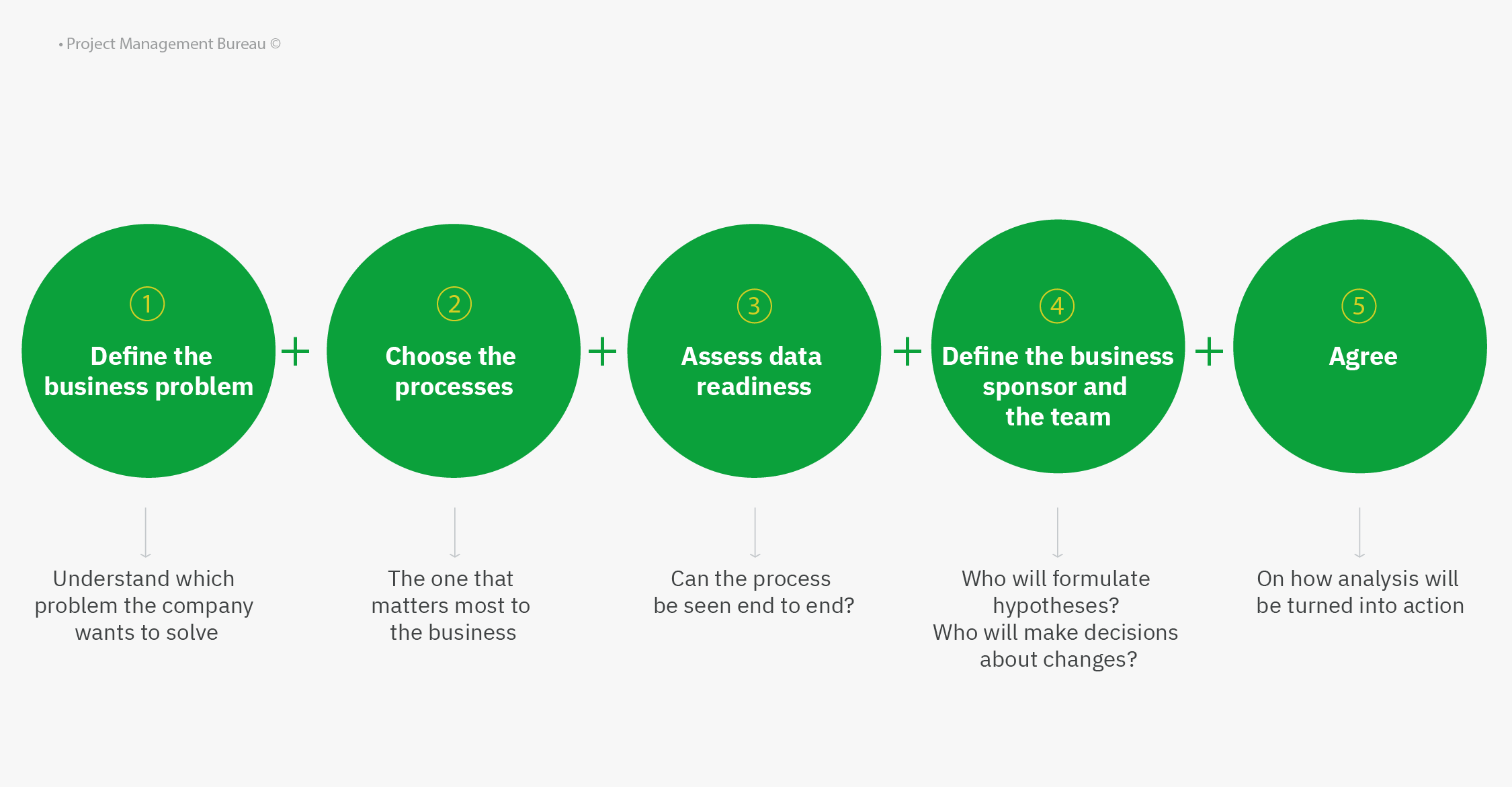
For process mining to deliver the expected result, the company needs to prepare before the technical implementation begins. In practice, there are five minimum steps.
Not “implement process mining”, but understand which problem the company wants to solve: reduce process time, lower costs, improve customer experience, or strengthen control.
The company should choose not the process that is easiest to analyse, but the one that matters most to the business.
Which systems are involved? Which events are recorded? Is there a single process identifier? Can the process be seen end to end?
Who will formulate hypotheses? Who will interpret the results? Who will make decisions about changes?
Without this, process mining risks remaining only a diagnostic exercise.
Process mining shows how a company actually works: with all its delays, exceptions, manual workarounds, and organisational compromises.
Process mining shows how a company actually works: with all its delays, exceptions, manual workarounds, and organisational compromises.
And for many organisations, this is where the hardest part begins: not simply seeing the problem, but working out how to solve it.
Choose a topic that interests you and read the most popular and useful articles from the Bureau: