Process mining has traditionally solved a fairly specific problem: showing how a process actually runs inside a company’s information systems. It gave organisations a way to see the real paths their processes followed, including delays, rework loops, deviations from the standard flow, and bottlenecks. But for many organisations, this now appears to be no longer enough.
This shift in expectations is reflected in Gartner’s new Magic Quadrant for Process Intelligence Platforms.
“The main change in the updated report is not the position of individual vendors, but the change in the category itself,” explains Oleksii Gromyko, Managing Partner at Project Management Bureau. “Previously, Gartner referred to Process Mining Platforms. Now it uses the category Process Intelligence Platforms. Companies no longer expect software products only to analyse processes. They also expect them to support management decision-making. This includes real-time process monitoring, AI-driven insights, identifying opportunities for optimisation, and creating a foundation for the further use of Enterprise AI.”
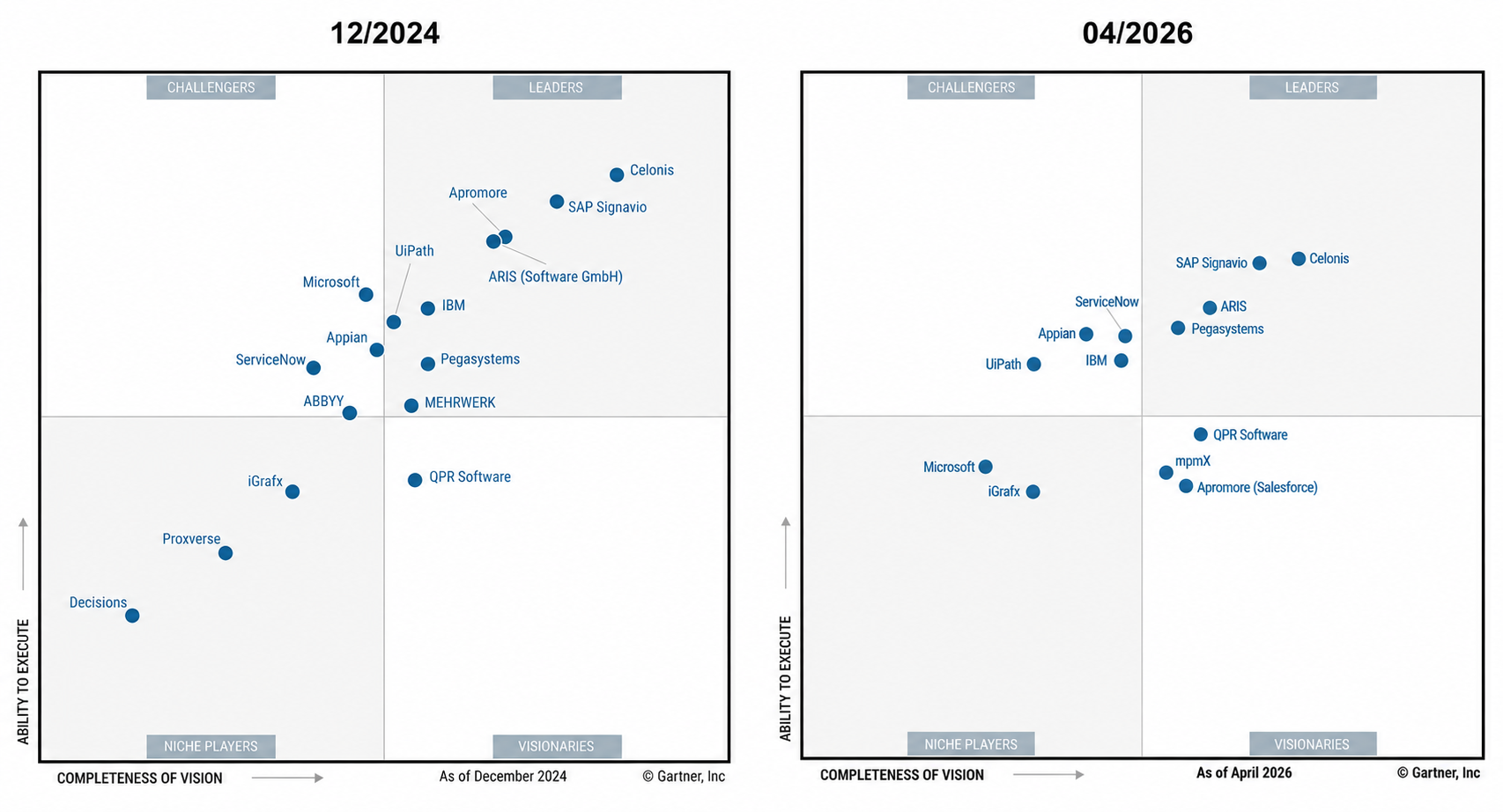
A comparison of the Magic Quadrant from December 2024 with the updated 2026 picture shows another important trend: the market has become more concentrated.
Many vendors are now positioned closer to one another, particularly in the central and upper parts of the matrix.
“This may indicate that the category is gradually maturing,” says Oleksii Gromyko. “Basic process mining functionality is becoming increasingly standardised. The ability to build a process map using real data is no longer enough on its own.”
Against the backdrop of broader market consolidation, individual players are moving differently.
“Among the vendors whose positions have visibly improved, Pegasystems and QPR Software stand out,” comments Oleksii. “At the same time, UiPath, IBM, and Microsoft appear less strong in this comparison. I would also point separately to Apromore. In 2025, its acquisition by Salesforce was announced. Any M&A deal creates a transition period. Product strategy, the roadmap, the go-to-market approach, and customer expectations about the platform’s future all begin to shift.”
The main conclusion from the new Magic Quadrant is that process mining is no longer a self-contained technology.
Competition will no longer centre on the ability to “build a process map”. That is gradually becoming basic functionality.
The next stage is about whether a product can:
This is where the key question arises: will companies use process intelligence not only to analyse processes, but to rethink how those processes are managed?
Choose a topic that interests you and read the most popular and useful articles from the Bureau: